


A Story of "Beyond Boundaries" and "Circulation"
From Asuka to the World: The Return of Culture Transcending 1,400 Years and a Prayer for "Beyond Boundaries"

1,400 years ago, Asuka was a "microcosm of the world." As the terminus of the Silk Road, cultural winds from Greece, Persia, India, and the Chinese continent flowed into this land. It was through the blending of these diverse cultures that the miraculous performing art known as "Gigaku" blossomed. Japan did not merely imitate this foreign culture; rather, through a continuous process of "acceptance and sublimation" driven by its own unique sensibility, it has cherished and preserved this art form.
Now, from this land of Asuka, we begin to "give back" to the world. It is a grand "story of circulation"—passing the cultural baton once received from the world back to the global stage, after 1,400 years of maturation.
The theme of "Beyond Boundaries" championed by this project holds a meaning far deeper than simply crossing borders on a map. It signifies bridging the "eras" of the ancient and the modern, transcending "genres" by fusing traditional performing arts with cutting-edge technologies like 3D printing, and above all, overcoming the barriers of disability and the walls of the heart that separate us. The "Gyodo" procession, where professional performers, local children, and people of all backgrounds meet through masks and walk together, is the very embodiment of "Beyond Boundaries."


The Performing Art that Journeyed the Silk Road: A Ship of "Multicultural Fusion" that Reached Asuka

Silk Road
Maritime Silk Road

Masks originating far to the west in Greece and Persia embarked on a grand journey across the ancient Silk Road. Crossing deserts and absorbing the colors of India and Central Asia, this performing art was polished by eagerly assimilating the music and cultures of every region it passed. It stands as the very embodiment of "multicultural fusion," where civilizations blend together.
Introduced to Japan in 612 AD by Mimashi of Baekje, "Gigaku" created a sensation in Asuka, a bustling international city of the era. Prince Shotoku saw infinite potential in its "power to communicate visually beyond language barriers" and utilized it as a cornerstone for spreading Buddhism and nation-building.
Asuka, the "terminus" where the torrent of civilization finally arrived, was a vibrant cultural crossroad at the time. With camels, peacocks, and people from foreign lands coming and going, it bustled with an energy akin to a World Expo.
However, Gigaku eventually vanished from the center stage of history, its true nature veiled in deep mystery. The internationally influenced masks resting in the Shosoin Repository and the Kyokunsho, a treatise on dance and music containing fragmentary records, became a "1,400-year time capsule" that miraculously conveys the spirit of that era.
The greatest allure of this art form lies in its duality: the coexistence of the "sacred," protecting Buddhist teachings, and the "comical," where drunkards and animals invite laughter. It is the "headwaters of Japanese performing arts," passed down as the DNA for all forms of traditional Japanese entertainment, including Noh, Kyogen, Kabuki, and the Lion Dance (Shishimai).
"Gigaku is a ship that has carried various cultures and characters."
Through the hands of Director Kaiji Moriyama, the world's oldest masked performing art is now set in motion once again as the cutting-edge art form "GIGAKU," transcending 1,300 years of time. The atmosphere of the former international city of Asuka stirs our modern sensibilities; a moment of "Beyond Boundaries" is about to begin.
The masks that once journeyed the Silk Road now embark on a new voyage—this time, from Asuka to the world.

迦楼羅

崑崙

治道

獅子
Gyodo Festival ~Asuka Road~ A Path Connecting Hearts and Time
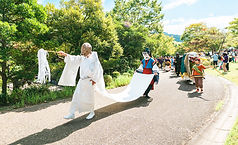
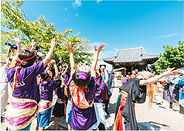
As the inaugural step of this project, we held the "GIGAKU Gyodo Festival ~Asuka Road~." A total of about 50 participants joined the procession, including Director Kaiji Moriyama, professional dancers, local residents, and local children participating as "Taishi Kids." They were clad in masks and costumes dyed with ancient natural dyes, which they had personally helped create.
The group paraded through the historic sites for approximately three hours. The musical troupe, incorporating traditional Japanese instruments, Arab drums, pianicas, and even daily items like frying pans, played a sound of "Beyond Boundaries" that transcended both time and borders, captivating the audience along the route.
As the inaugural step of this project, we held the "GIGAKU Gyodo Festival ~Asuka Road~." A total of about 50 participants joined the procession, including Director Kaiji Moriyama, professional dancers, local residents, and local children participating as "Taishi Kids." They were clad in masks and costumes dyed with ancient natural dyes, which they had personally helped create.
The group paraded through the historic sites for approximately three hours. The musical troupe, incorporating traditional Japanese instruments, Arab drums, pianicas, and even daily items like frying pans, played a sound of "Beyond Boundaries" that transcended both time and borders, captivating the audience along the route.
Organizer: GIGAKU Project Executive Committee
Co-organizers: Nara Prefecture Complex of Man'yo Culture, Will Arts (General Incorporated Association)
Supported by: World Heritage "Asuka-Fujiwara" Registration Promotion Council
Cooperation: Asuka Tourism Association, Asuka Historical National Government Park, Asuka-dera, Tachibana-dera, Gufuku-ji (Kawahara-dera Site)
Artistic Director: Kaiji Moriyama
Music: Yasuhiro Kasamatsu
Mask & Costume Design: Kaiji Moriyama Mask Modeling Design: GK Kyoto Production
Cooperation: eno design, Okamura Kobo / Costume Production: Maya / Ancient Natural Dyeing: Mizutani Natural Dyeing / Bird Call: Asuka String Instruments / Gigaku Adviser: Shunsuke Tatsumi / Photography: Asukairo, Video Shooting, EditingY oshimoto Kogyo
Special Thanks: Asuka Village, Parents and Guardians, Lead Co., Ltd., Kaiji Moriyama Office Co., Ltd.
Agency for Cultural Affairs, Fiscal Year 2025 "Subsidy for Cultural Resource Utilization Projects (Project to Promote the Utilization of Attractive Cultural Assets in Various Regions)" Adopted Project
Organizer: GIGAKU Project Executive Committee
Co-organizers: Nara Prefecture Complex of Man'yo Culture, Will Arts (General Incorporated Association)
Supported by: World Heritage "Asuka-Fujiwara" Registration Promotion Council
Cooperation: Asuka Tourism Association, Asuka Historical National Government Park, Asuka-dera, Tachibana-dera, Gufuku-ji (Kawahara-dera Site)
Artistic Director: Kaiji Moriyama
Music: Yasuhiro Kasamatsu
Mask & Costume Design: Kaiji Moriyama Mask Modeling Design: GK Kyoto Production
Cooperation: eno design, Okamura Kobo / Costume Production: Maya / Ancient Natural Dyeing: Mizutani Natural Dyeing / Bird Call: Asuka String Instruments / Gigaku Adviser: Shunsuke Tatsumi / Photography: Asukairo, Video Shooting, EditingY oshimoto Kogyo
Special Thanks: Asuka Village, Parents and Guardians, Lead Co., Ltd., Kaiji Moriyama Office Co., Ltd.
Agency for Cultural Affairs, Fiscal Year 2025 "Subsidy for Cultural Resource Utilization Projects (Project to Promote the Utilization of Attractive Cultural Assets in Various Regions)" Adopted Project
GIGAKU行道2025のイメージ


シルクロードを辿り、飛鳥へ。/GIGAKUプロジェクト実行委員会
1400年前に飛鳥へ伝わった仮面芸能「伎楽」は、鎌倉時代に途絶え、当時の演じ方は書物『教訓抄』に断片的に残るのみで深い謎に包まれています。この幻の芸能を現代の「GIGAKU」として蘇らせるため、私たちは伎楽伝来の地、明日香村で、「GIGAKUプロジェクト実行委員会」を発足しました。
私たちの指針となったのは、森山開次氏が、NHK BS『GIGAKU!踊れシルクロード』(2023年初回放送)で見せた探求の姿です。森山氏は、伎楽のルーツを求めてインド、ウズベキスタン、バリ、ジャワなどを歴訪し、シルクロードを旅し、かつて伎楽が異文化と交わりながら飛鳥へ伝来したプロセスを自らの身体で追体験し、独自の伎楽を創り上げました。
その映像に深く共鳴した私たちは、森山氏をアーティスティック・ディレクターとして招き、「越境のGIGAKU」を新しく創り上げることにしました。明日香村に新たな文化として根付き、これから1000年続くことを目指します。
アーティスティック・ディレクター:森山開次
「飛鳥の風景の中を歩くのは心地よく、生きる喜びを感じました。伎楽は出会いの芸能であり、人と人をつなげる力があります。新しい伎楽をつくる一歩を踏み出せました」

©Tomohide Ikeya
神奈川県出身。21歳でダンスを始める。想像力豊かな独自の作品世界で観客を魅了する、現代のダンスシーンを牽引するアーティストの一人。2005年、自身の演出・振り付けによるソロダンス『KATANA』でニューヨークタイムズ紙に「驚異のダンサー」と評され、ヴェネツィア・ビエンナーレ招聘。2021年 東京2020パラリンピック開会式演出・チーフ振り付け。2023-24年 舞台『千と千尋の神隠し』カオナシ役。演出振り付け、出演した舞台『TRAIN TRAIN TRAIN』で2026年芸術選奨文部科学大臣賞受賞。本年 愛知・名古屋2026アジアパラ競技大会開閉会式演出統括をつとめるなど、ダンサー、演出家の両面で唯一無二の活動を展開。2023年NHKBSにて放送された「GIGAKU!踊れシルクロード」(現在配信中)にて、伎楽のルーツを求めシルクロードを旅した。
A Story of "Beyond Boundaries" and "Circulation"
1,400 years ago, Asuka was a "microcosm of the world." As the terminus of the Silk Road, cultural winds from Greece, Persia, India, and the Chinese continent flowed into this land. It was through the blending of these diverse cultures that the miraculous performing art known as "Gigaku" blossomed. Japan did not merely imitate this foreign culture; rather, through a continuous process of "acceptance and sublimation" driven by its own unique sensibility, it has cherished and preserved this art form.
Now, from this land of Asuka, we begin to "give back" to the world. It is a grand "story of circulation"—passing the cultural baton once received from the world back to the global stage, after 1,400 years of maturation.
The theme of "Beyond Boundaries" championed by this project holds a meaning far deeper than simply crossing borders on a map. It signifies bridging the "eras" of the ancient and the modern, transcending "genres" by fusing traditional performing arts with cutting-edge technologies like 3D printing, and above all, overcoming the barriers of disability and the walls of the heart that separate us. The "Gyodo" procession, where professional performers, local children, and people of all backgrounds meet through masks and walk together, is the very embodiment of "Beyond Boundaries."
A Story of "Beyond Boundaries" and "Circulation"
From Asuka to the World: The Return of Culture Transcending 1,400 Years and a Prayer for "Beyond Boundaries"
From Asuka to the World: The Return of Culture Transcending 1,400 Years and a Prayer for "Beyond Boundaries"

A Story of "Beyond Boundaries" and "Circulation"
From Asuka to the World: The Return of Culture Transcending 1,400 Years and a Prayer for "Beyond Boundaries"


A Story of "Beyond Boundaries" and "Circulation"
From Asuka to the World: The Return of Culture Transcending 1,400 Years and a Prayer for "Beyond Boundaries"


A Story of "Beyond Boundaries" and "Circulation"
From Asuka to the World: The Return of Culture Transcending 1,400 Years and a Prayer for "Beyond Boundaries"
From Asuka to the World: The Return of Culture Transcending 1,400 Years and a Prayer for "Beyond Boundaries"

Call for Support: About the Artistic Activity Fund
To ensure the sustainable operation of this project and to continue contributing to the protection of cultural properties and regional revitalization, Will Arts (General Incorporated Association), one of the operating entities, is seeking donations from the public. Your contributions will be carefully utilized through the "Artistic Activity Fund" for the production of GIGAKU costumes and masks, performance operations, and cultural property protection activities.
-
Donation Desk: Will Arts (General Incorporated Association), Artistic Activity Fund
-
Details & Application: Please contact the secretariat.